

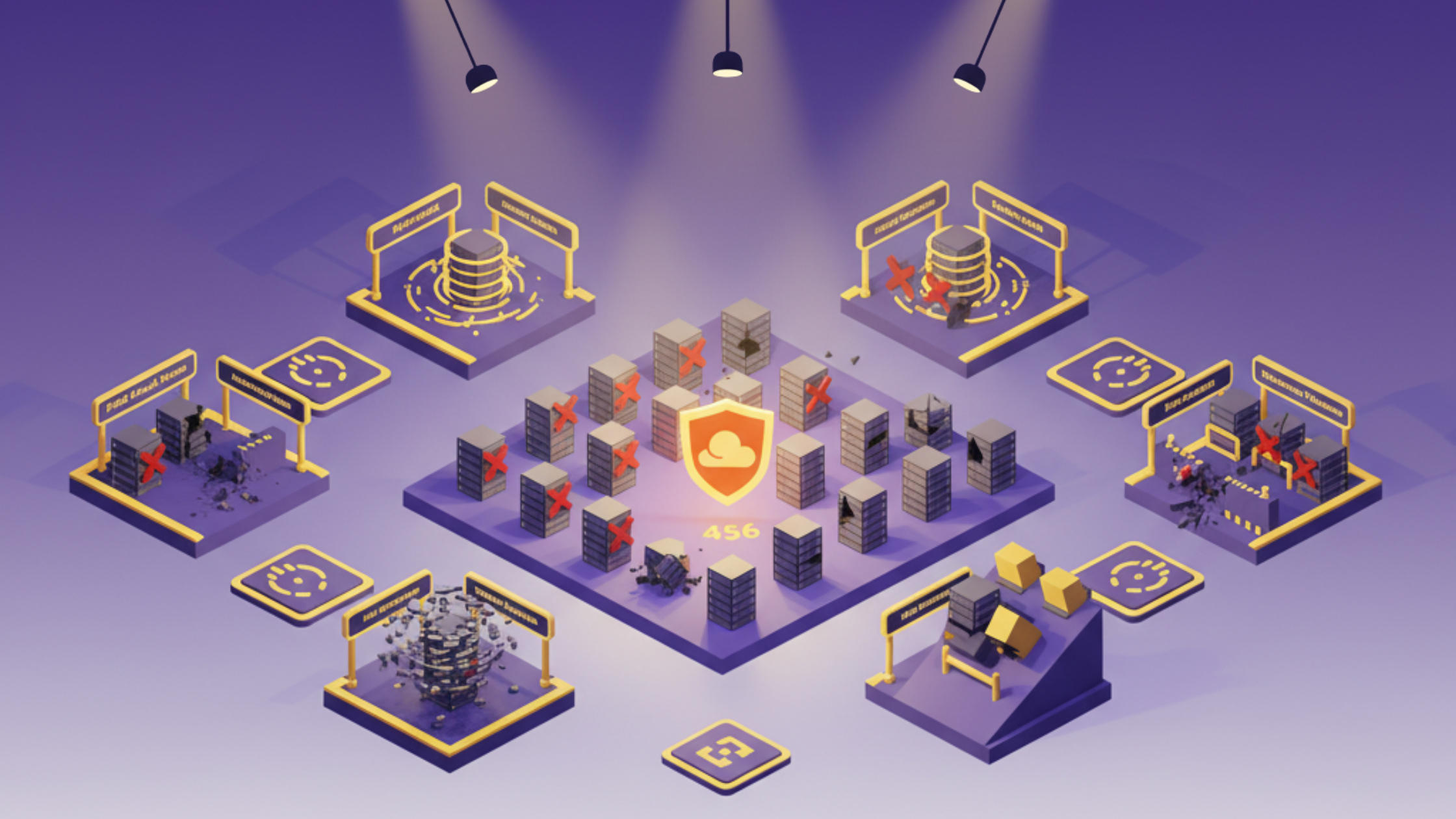
Introduction: the couch-thriller continues in the server room
On September 17, 2021, Squid Game became a global sensation within a week. While we watched Player 456 fight for survival, IT leaders faced a very real “game”: servers going down, systems crashing, revenues evaporating. In 2025, with total views surpassing 600 million, the core lesson still holds: the winner isn’t the strongest, but the best prepared. In IT, that means Cloudflare protection against DDoS “elimination.”
Player 456 numbers: the cold reality behind the cult
Netflix dominance:
- 1.65 billion hours watched in the first 28 days (~182,000 years of streaming)
- 111 million viewers in the first month; #1 series worldwide
- Top 10 in 94 countries; first Korean #1 in the US
- ~$891M value created for Netflix vs. ~$21.4M production cost
Cultural impact:
- +7,800% Vans shoe sales
- +40% learners of Korean on Duolingo
- Tens of thousands of “pink guards” in campaigns worldwide
What does this have to do with IT? Everything. The modern business arena works the same way: 456 companies enter, only those who prepared stay standing.
Game #1 – Red Light, Green Light: DDoS protection on/off
In the game, the doll tracks motion: green = go; red = elimination. In business, a DDoS attack flips the light to red: congestion spikes, the site goes down.
- Significant year-over-year growth in attack counts (double-digit)
- ~39 minutes average incident duration → hundreds of thousands of USD per attack
- Finance, telecom, and healthcare hit by combined volumetric + application-layer vectors
Lesson #1 – Motion sensing with timed intervention:
Effective defense = anomaly detection + automatic traffic filtering:
- baseline normal traffic → 2) detect suspicious patterns → 3) separate legitimate vs. malicious → 4) targeted block/allow.
Late reaction means elimination here, too.
Game #2 – Honeycomb Challenge: precision infrastructure
Cutting shapes from dalgona requires precision and the right tool. In IT, the “honeycomb” is your layered architecture:
- Web layer: interface & UX
- Application layer: business logic
- Data layer: databases & sensitive info
- Network layer: connectivity & routes
- Infrastructure: servers, storage, compute
Lesson #2 – Layer-specific protection: each layer needs its own controls (WAF, bot management, DLP, L7 rules, caching policy). One wrong move and the whole “shape” cracks.
Game #3 – Tug of War: bandwidth pull
During DDoS, the “rope” is bandwidth and capacity. The botnet pulls; your infrastructure holds.
Lesson #3 – Strategy beats brute force:
- Edge positioning (CDN, Anycast)
- Proactive detection instead of reactive firefighting
- Automation + expert oversight
- Use attacker momentum: dynamic routing and rate control
Game #4 – Marbles: trust and verify (supply chain)
Remote providers, APIs, ISPs, cloud — who do you rely on?
Lesson #4 – Diversified survival strategy:
- Multi-vendor / multi-region
- Redundancy for critical components
- Independent testing and validation
- Disaster recovery (DR) playbooks
Game #5 – Glass Bridge: tech choices before you step
Every step is a decision: cloud or on-prem, open source or proprietary, single- or multi-vendor, reactive or proactive security.
Lesson #5 – Test before you step:
- Continuous vulnerability assessment
- Red team exercises
- Load testing (capacity verification)
- DR drills (business continuity)
Game #6 – Squid Game: the final cut
The 2025 reality: AI-assisted attacks, larger botnets, multi-vector complexity. Those who fail to prepare are eliminated; those who do gain market advantage.
Cloudflare: the 2025 “survival kit”
The winning combo in the series — strategy + resource management + adaptability — translates to Cloudflare in IT.
Global network & capacity
- Hundreds of PoPs worldwide, massive mitigation reserves
- Anycast distribution, low latency, local presence
Machine-learning detection
- Millisecond-level anomaly detection
- Behavioral analysis, continuous self-tuning
Automated, surgical response
- Layer-agnostic protection (L3–L7)
- Block bad traffic, pass through legitimate requests
Step-by-step rollout: turning red into green
- Attack-surface map: endpoints, services, regions
- Layered controls: edge, network, app, data — tailored rules
- Incident runbooks: escalation, comms, recovery
- Operations: 24/7 monitoring, regular “game days,” feedback loops
- Optimization: measure → tune → automate
Closing: 456 companies start — which one are you?
Squid Game teaches that rules are simple, survival needs strategy. In 2025 the “game” is harsher, the eliminations real. With Cloudflare and proactive DDoS defense, you start with Player-456 advantage.
Ready to switch to green?
Gloster Cloud designs and deploys Cloudflare-based DDoS and Zero Trust architectures — audit, pilot, full rollout.


