


IT Health Check: What Should We Pay Attention to in 2026?
“Doctor, everything works perfectly in our IT environment… until suddenly everything stops.”
Over the past few years, I’ve heard this sentence from countless IT leaders.
My name is Dr. IT. I work in the field of IT Health, and when we examine a company’s IT systems, the process often resembles a medical examination.
The patient feels perfectly fine…
until a routine check-up reveals a serious issue.
IT systems behave the same way.
In many companies, systems appear stable on the surface, but in the background early warning signs have already appeared that can later lead to:
- a complete system outage
- a security incident
- or serious business disruption.
That is why we are increasingly talking about IT health assessments.
Just like in the human body, the same rule applies to IT infrastructure:
prevention is always cheaper than treatment.
What Is an IT Health Assessment?
An IT health check is a structured evaluation that identifies potential issues in a company’s IT infrastructure, including:
- performance problems
- security risks
- capacity limitations
- operational vulnerabilities.
Simply put, it is a complete diagnostic examination of a company’s IT systems.
In modern organizations, IT infrastructure is the backbone of business operations. It is no coincidence that more and more companies are building their environments on cloud platforms such as Azure cloud solutions, which provide greater scalability and reliability.
Blood Pressure Measurement vs. Network Monitoring
One of the simplest yet most important medical examinations is blood pressure measurement.
Why?
Because it quickly reveals when something is wrong.
In IT environments, monitoring and system observability play the same role.
Without proper monitoring:
- problems are detected too late
- system performance deteriorates
- users start to complain
- systems may even fail completely.
However, with proper IT monitoring, problems can be detected much earlier.
This is why modern organizations rely on continuous IT monitoring and infrastructure operations solutions that observe system health in real time.
According to Microsoft, proactive monitoring and automated operations are essential for maintaining stable modern IT infrastructures.
The Real Cost of IT Downtime
Many companies only realize how critical IT infrastructure is once a system outage has already occurred.
Yet the numbers speak for themselves.
According to the IBM Cost of a Data Breach Report, downtime and security incidents represent significant business risks.
Industry research shows that:
- in more than 90% of companies, IT downtime costs exceed $300,000 per hour
- 41% of large enterprises lose more than $1 million per hour during outages
- 60–80% of IT outages are caused by configuration errors or human mistakes
This is why modern cybersecurity solutions and continuous security monitoring are essential.
The NIST Cybersecurity Framework also emphasizes that organizations must continuously monitor their IT environments in order to reduce risk.
IT Health Check: The 15-Point Self-Assessment Checklist
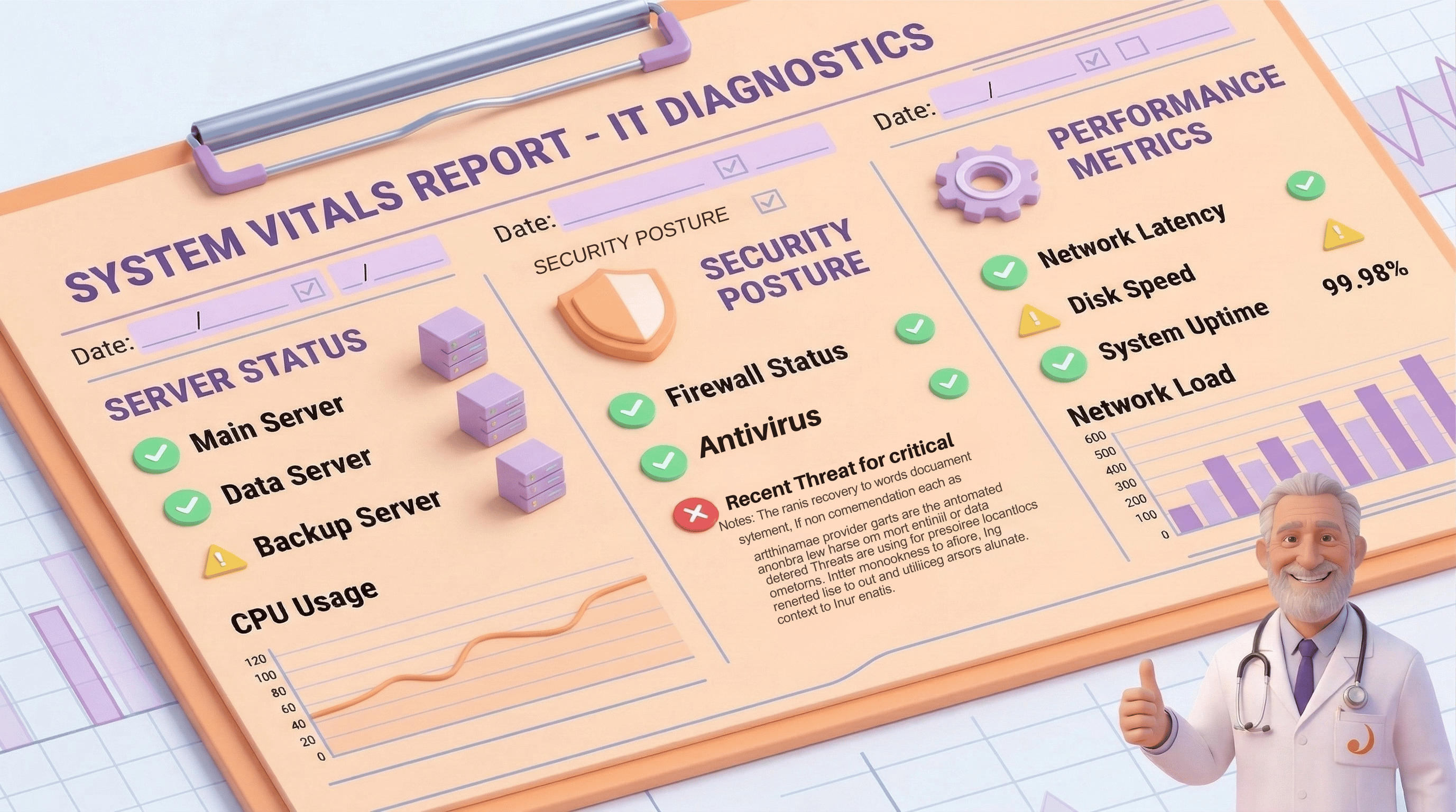
If you want a quick overview of your company’s IT health, start with this 15-point IT health check self-assessment.
Infrastructure
- Do you have continuous network monitoring?
- Are server CPU and memory usage monitored?
- Do you perform regular capacity planning?
- Is your IT infrastructure properly documented?
- Do critical services have redundancy?
Security
- Are security updates applied regularly?
- Do all devices have endpoint protection?
- Do you use multi-factor authentication (MFA)?
- Do you have centralized log monitoring or a SIEM system?
- Are backup restoration processes tested regularly?
Operations
- Do you have a documented incident response plan?
- Are IT operational processes documented?
- Do you have 24/7 monitoring or SOC support?
- Do you measure system availability and uptime?
- Has a full IT health audit been conducted in the past year?
If the answer to several questions is no, it may be time for a full IT assessment.
What Should We Watch in 2026?
IT environments are becoming increasingly complex.
In recent years, three areas have become especially critical.
AI and Automation
AI-driven systems are playing an increasingly important role in IT operations.
Microsoft, for example, is already using AI-based technologies for infrastructure monitoring and fault detection.
Cloud Infrastructure
Companies are increasingly operating their systems in hybrid and multi-cloud environments.
This means that IT health checks must also cover cloud platforms such as Azure cloud infrastructure.
Cybersecurity
Modern cyberattacks are faster and more sophisticated than ever.
According to the annual Cloudflare Threat Report, the number of attacks targeting organizations continues to grow.
For this reason, IT health has become a business-critical issue.
Maintaining IT Health Is an Ongoing Process
There is a fundamental rule in medicine:
prevention is always cheaper than treatment.
The same principle applies to IT systems.
Regular:
- monitoring
- audits
- security assessments
- performance analysis
help prevent critical failures before they occur.
IT Health Month – Dr. IT Is in the Office
During the IT Health campaign, we help companies evaluate the condition of their IT systems.
Dr. IT and the experts at Gloster Cloud conduct a comprehensive IT health assessment that:
- identifies critical risks
- analyzes infrastructure performance
- provides recommendations for improvement.
If you would like to find out how healthy your company’s IT systems really are, join the IT Health Month program.
Dr. IT is in the office — and now it may be your system’s turn for a check-up.


